

Ranking isn’t about repeating a keyword twenty times. It’s about answering the question someone has just typed into the search engine better than anyone else, in a way that reads well and makes it clear there’s a person behind it who knows the subject. This guide explains how to write content that ranks without sounding like a robot: how to choose the approach, what the data says about length, how to structure the text and what role artificial intelligence can play.
What follows draws on published studies and Google’s own documentation. Where the data doesn’t let us state something with certainty, we say so.
Quick summary
- Before writing, define the search intent: what the person searching for that term wants to achieve.
- Length is not a ranking factor (Google has said so); covering the topic better than the rest is.
- Structure the text for people who scan: clear headings, short paragraphs, lists and tables.
- You can use AI as an assistant, but the experience, the data and the judgment are yours.
- Updating old content usually pays off more than publishing new content.
In this article
Start with search intent
Before writing a line, ask yourself what the person searching for that term needs. Someone comparing prices isn’t the same as someone who wants to learn how to do something on their own. Each intent calls for a different type of content:
| Intent | What the person wants | Format that usually works |
|---|---|---|
| Informational | Learn or resolve a question | Guide, explanatory article, list |
| Comparison | Choose between options | Comparison table, analysis with criteria |
| Transactional | Hire or buy | Service or product page with a clear action |
| Navigational | Reach a specific brand or site | Homepage, contact or login page |
The most reliable way to check is to search the term yourself and look at what Google shows: if guides come up, write a guide; if service pages come up, don’t insist on a blog article. If the term is transactional, the right place is a service page like our technical SEO and ranking page, and the blog serves to attract people who are still learning.
How long should an article be?
It’s the most repeated question, and the one that generates the most myths. Here’s what can be stated with data:
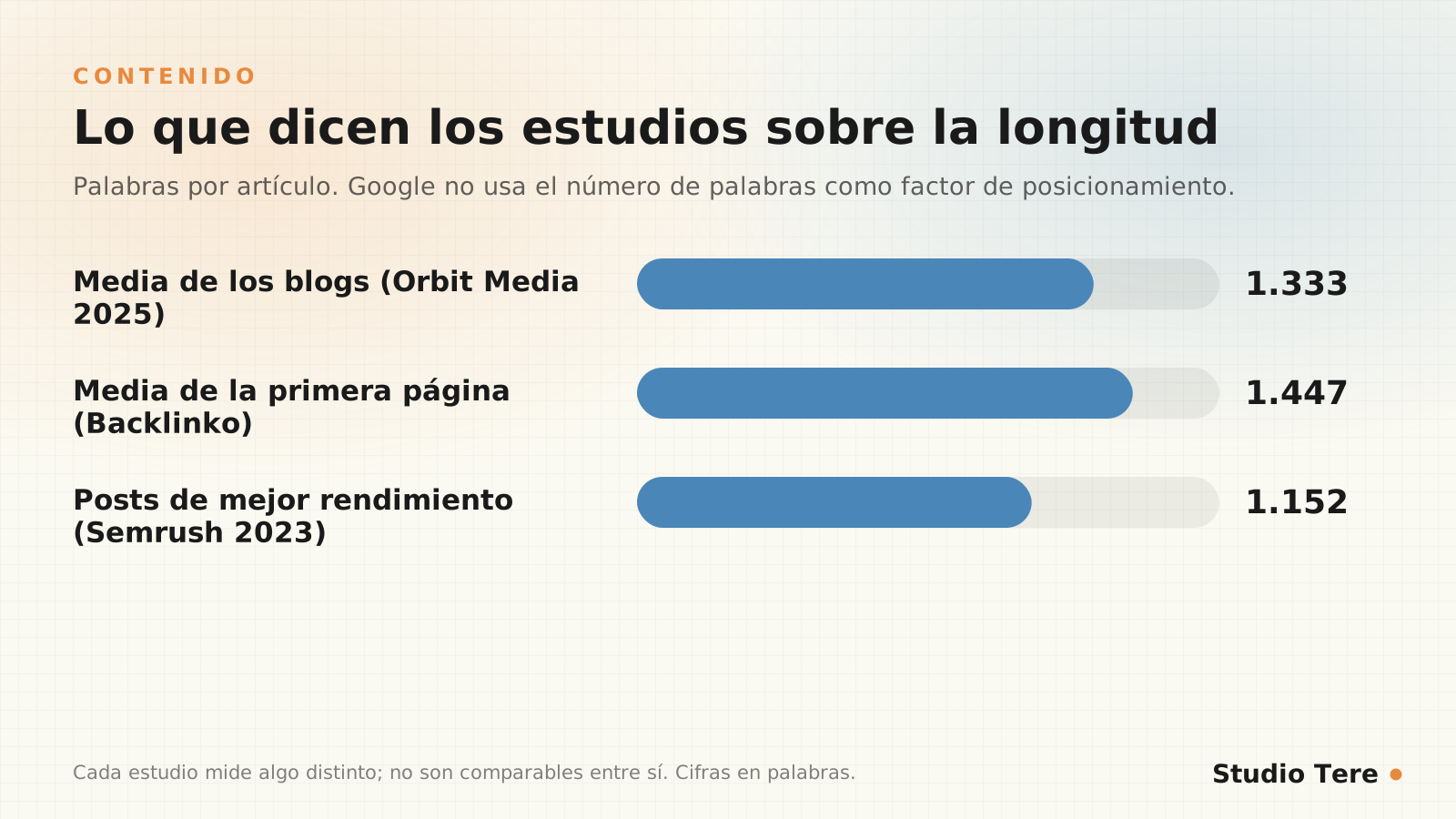
- According to Orbit Media’s annual survey, the average article has 1,333 words in 2025, and only 9% of bloggers regularly publish pieces over 2,000.
- A Backlinko analysis of 11.8 million results put the average for Google’s first page at around 1,447 words.
- Semrush calculated that the best-performing articles average around 1,150 words, versus 670 for the worst-performing ones.
These figures can’t be compared with each other (each study measures something different) and, above all, they are correlations: texts that rank tend to be long because they cover broad topics, not because length makes them rank. Google has said it bluntly: John Mueller stated that word count is not a quality or ranking factor.
Write what the topic needs to be well resolved. If you have words to spare, cut; if examples are missing, add them.
Editorial judgment
A practical rule: search your term, open the first five results and look at what they cover. Your text should cover everything important that they cover and add something they don’t have: a data point, an example, a template, a personal experience.
A structure designed for people who scan
Most people don’t read: they scan. A good text lets you grasp the main idea just by running through the headings and, if something interests you, dig deeper. This helps:
- A title (H1) that promises something specific and delivers, with the main keyword used naturally.
- A short introduction that says what the article will solve and who it’s for.
- A summary at the start with the essentials, for those who just want the answer.
- Subheadings (H2 and H3) that describe the content, not “decorate.”
- Paragraphs of three to four lines, with one idea per paragraph.
- Lists and tables when there are steps or comparisons.
- A closing with a clear next step.

How to write with a human voice
A text sounds like a robot when it says nothing specific. Google puts it in other words in its guide to helpful, people-first content: it values content that demonstrates first-hand experience, knowledge of the topic, authoritativeness and trustworthiness. This translates into concrete habits:
- Be specific. Swap “improve your performance” for what gets improved, by how much and how it’s checked.
- Use real examples, even small ones: a case, a screenshot, a figure with its source.
- Cite your sources. Linking to studies and documentation builds trust and forces you to be precise.
- Say what you don’t know. “There’s no conclusive data” is more credible than an invented certainty.
- Avoid filler phrases and generic openers like “nowadays” or “we live in a world…”.
- Write the way you talk to a client, but with your ideas in order.
Writing with artificial intelligence: what to do and what not to
You probably use AI to write, or someone around you does. Google’s stance is nuanced: AI-generated content isn’t prohibited in itself; what it penalizes is publishing content at scale whose main goal is to manipulate rankings rather than help people (what its spam policies call scaled content abuse). In practice:
- Yes: use it to organize ideas, propose outlines, summarize sources or review style.
- Yes: add your own experience, data and judgment, and verify every claim.
- No: publish the text as it comes out, without reviewing or checking facts.
- No: produce dozens of nearly identical articles just to cover keywords.
A simple test: if you remove your name and your brand, could anyone have written the text? Then you’re missing your own experience.
An editorial process you can repeat
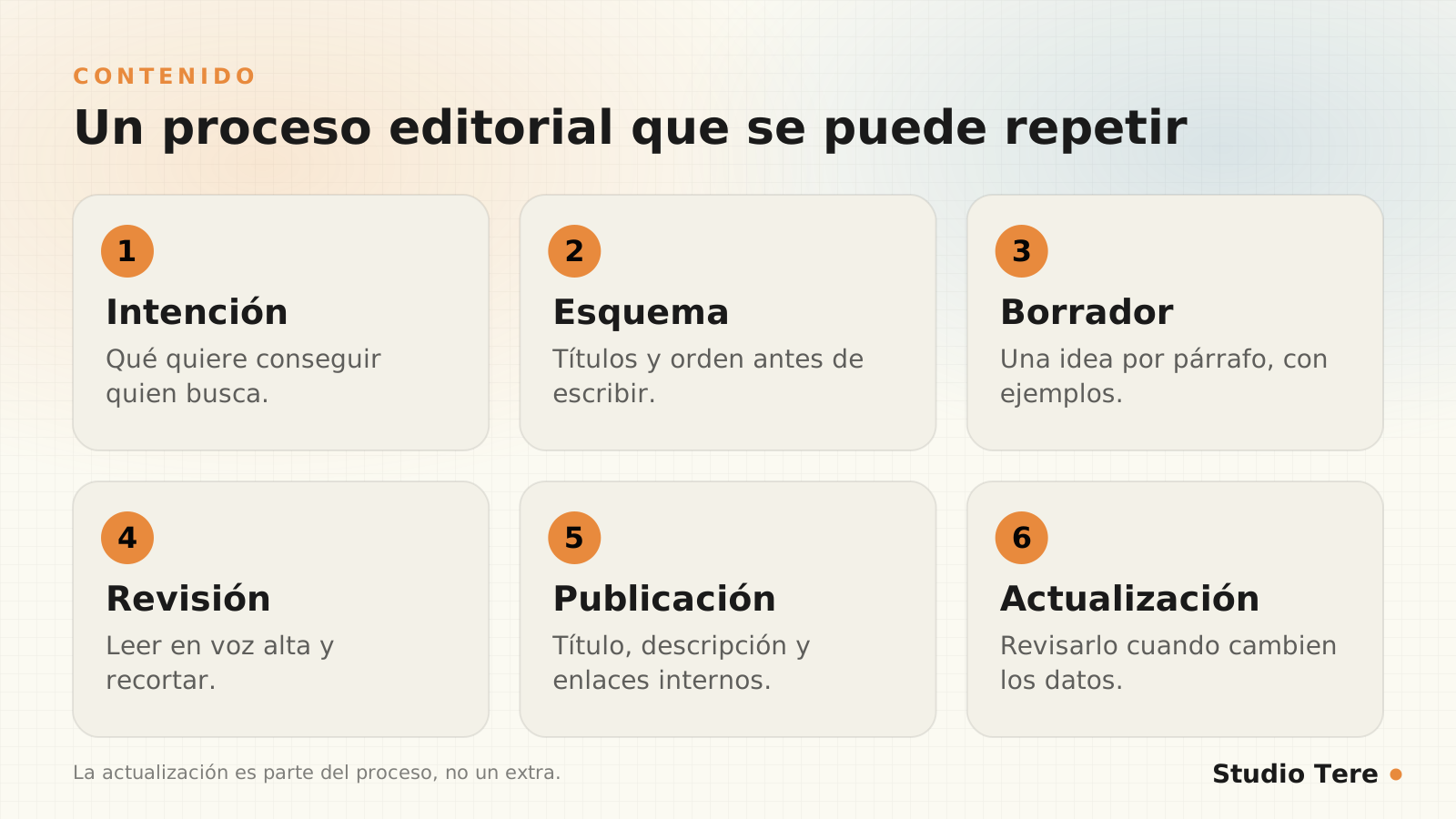
- Intent: define who is searching, what they need and what format they expect.
- Outline: headings and order before writing; that way you avoid rambling.
- Draft: one idea per paragraph, with examples and sources.
- Review: read it aloud, cut repetitions and check facts.
- Publishing: title, description, images with alt text and internal links.
- Update: revisit it when the data or the competition changes.
Essential on-page SEO, without obsessing
Good content needs a clear way in. These details have an impact and cost little:
- SEO title: Backlinko observed that titles of 40 to 60 characters get a better click-through rate. Google sets no exact limit, so prioritize clarity (more in its guide to title links).
- Meta description: an honest summary that invites clicks, of about 140 to 155 characters.
- Short, descriptive URL: according to Backlinko, those containing terms from the search get 45% more clicks.
- Images with descriptive alt text and reasonable file size.
- A single H1 and a logical hierarchy of H2s and H3s.
Ranking matters because clicks concentrate at the top: according to Backlinko, the first Google result gets around 27.6% of clicks, and second-page results get less than 1% each (Sistrix data). That’s why a good title and a good description aren’t a detail.
Link thoughtfully and update what you already have
Internal links help people keep reading and help search engines understand how your pages relate. Link when it adds value, with descriptive text (not “click here”), to services, related guides and categories. On this blog, for example, each guide links to its sibling articles and to the relevant service, as in our guide to technical SEO before launching your website or the one on Core Web Vitals.
And update. According to Orbit Media data collected by Semrush, the share of bloggers who update old articles went from 53% in 2017 to 74% in 2023. It’s one of the most profitable investments: you already have the topic, the URL and part of the authority.
Outline template to get started
H1: [Palabra clave] + promesa concreta

Introducción (3-4 líneas): para quién es y qué resuelve
Resumen rápido (3-5 puntos)

H2: Qué es / por qué importa
H2: Cómo hacerlo paso a paso
  H3: Paso 1 ... Paso N
H2: Errores frecuentes
H2: Ejemplo real o caso
H2: Preguntas frecuentes (3-5)

Cierre: siguiente paso + enlaces internos
Fuentes
Frequently asked questions
How many words should an article have to rank?
There’s no magic number. Google has said word count is not a ranking factor. Studies show averages of between 1,100 and 1,500 words for content that performs well, but they’re correlations: what matters is covering the topic better than the results already ranking.
Can I use AI to write my blog?
Yes, as an assistant, as long as you verify the data, add your experience and publish only what truly helps the reader. What Google treats as spam is mass production of content with no value.
How often should I publish?
With consistency, not volume. One carefully crafted article a month is better than four mediocre ones. And set aside time to update what you’ve already published.
Do keywords still matter?
Yes, as a guide to understand what people search for, but not as a formula. Use the term and its variants naturally in the title, introduction and section headings; don’t repeat for the sake of repeating.
Is a blog useful if my website is for services?
It’s useful for attracting people who are still gathering information and for showing expertise, but conversion happens on your service pages. Connect the two with clear internal links.
Want a solid technical foundation for your content?
We work on SEO as an ongoing process: structure, search intent, performance, indexing and measurement. Without promising rankings that nobody can guarantee.
Sources and recommended reading
- Google Search Central: creating helpful, reliable, people-first content
- Google Search Central: title links
- Orbit Media: annual blogger survey (via MarketingProfs)
- Backlinko: Google CTR study
- Search Engine Journal: Google says word count is not a quality factor
- Search Engine Journal: Sistrix study on first-page clicks